

Being Black is a Love Story
By: Breana Newton
Edited By: Emily Saigh
Everything I know about love has come from the weathered pages of a novel, and everything I know about failure comes from the implosion of my marriage. It was through that breakdown, and the sense of profound grief of failing at something my twenty-year-old self had convinced all my elders would work, that I learned to fall back in love with myself. Black romance led the charge.
We need to start at the beginning of my great awakening! I am a third-generation (Mom, check me if I’m wrong) Black woman who was born and raised in a small college town with a shit ton of affluent white people. A town whose beauty standards are centered on whiteness. Where even the most confident Black girl can find herself questioning whether or not she’s ‘beautiful’ because the girls who are consistently chosen look nothing like her.
Granted, I suffered from an extreme lack of confidence- at least that’s what I’m blaming my questionable track record with men on. I mean, I was a TWENTY-YEAR-OLD-CHILD who ended up in my marriage because I met him, he gave me attention, and I was able to “steal” his attention from someone else that night. . . . I was a sucker for being a pick-me who ended up getting picked, and we know how that ended up.
My view on love has been a roller coaster. I am the product of an uncomfortable union—drug-filled with a very questionable power dynamic—dad who was the drug dealer and mom who was the drug addict. It comes as no surprise I grew up having never seen a good or healthy version of love, and my reflex is desperation. To grasp on to love with a tendency to fight with all I've got. To keep it even when it no longer serves me.
Imagine growing up and being reminded often you are not the beauty standard and your Blackness is the main reason why. The Black guys don’t like you (they prefer the white girls), and the white guys view you as a fun time, but definitely not somebody they can take home to mommy and daddy. With that piece of knowledge tucked away for safe keeping, you start to internalize and somewhat despise your Blackness. So, you do the only thing you know how to do.
What does that really do to you though? It has you punched in the face, often with reminders that you are BLACK before you are a woman. No matter how many Black books you avoid or Colleen Hoover critique videos you post, there will always be something missing from your reading experience. The romance, the fantasy, the mystery of it all will always be missing something, and that something is someone who looks like you. Someone who understands how deeply being othered feels and how much you want to get back to your roots and feel alive again.
My divorce was a reckoning of sorts. There was a Before Breana and there is now the After Breana. The divorce forced me to look in the mirror and ask myself who I was hurting by trying to downplay or hide such a large part of myself. The answer was only ever me. Was I a masochist or did I feel I didn’t deserve to embrace my Blackness? Or did I feel comfort in being othered because it was a home of sorts?
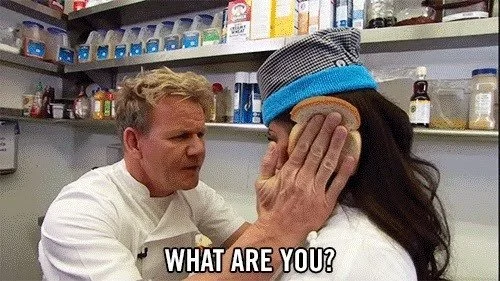
The After Breana is no longer an idiot sandwich (shout out to Gordon Ramsey for such an iconic episode), and she has done the work and continues to. However, I need you to know what I found out during my desperate search for finding books where I was no longer the other, where everybody in that bitch looked like me, talked like me, and had chaos like mine. Books where I didn’t have to shed my identity to ‘fit’ myself into it. Where my identity was already catered to and the jokes needed no explanation and the mess felt like a homecoming with a welcome mat waiting for me to wipe off my sneakers and sit down for a bit.
There is a moment from Before I Let Go by Kennedy Ryan that feels like a warm hug on a cold day: “When you hurt the way we women sometimes have to, when you lose so much, when the world ends over and over and over again, we are no longer butterflies. Those wings are much too fragile to carry us on and through. I’m a hornet. I can love. And I can sting.” Kennedy reminds us we can carry our pain and still find love, and we are all the stronger for it.
There's something incredibly beautiful about finding your home inside the pages of a book, being able to strip off the outside world, get comfy on the couch, and get lost in the stories of MY people. Where the girls are a mix of messy and loud but sooo fucking badass. Where the men who have a hard exterior shed it to bask in their softness with the Black women who help them feel seen. In Maybe for the Summer by Aubreé Pynn, there is a moment where Deja tells Juju (two Black leads), “No one has held you. You deserve to be held. You deserve to be seen and you got to know you're more than enough." It was as if Deja was pulling the reader in for a warm hug after spending a lifetime running, to remind us, Black woman to Black woman, we are safe to land here and our Blackness is more than enough.
With each book I read and log into my StoryGraph (the Black-owned book app), it feels like another piece of myself is being stitched back together. Within these books, Blackness is the blueprint and it is celebrated, not tolerated, and the girls who look like me get their happily ever after. As Evelyn Latrice reminded us in The 19th Hole, “‘You came in here talking about legacy,’ he said, ‘but Black love is part of that too. Our people ain’t survive on land alone. They survived because they held each other. They survived because when one person was about to fall, the other one lifted them . . . you forgot that part.’” Black love is the legacy built on the back of undisputed Blackness, and I’ll never stop believing in it.